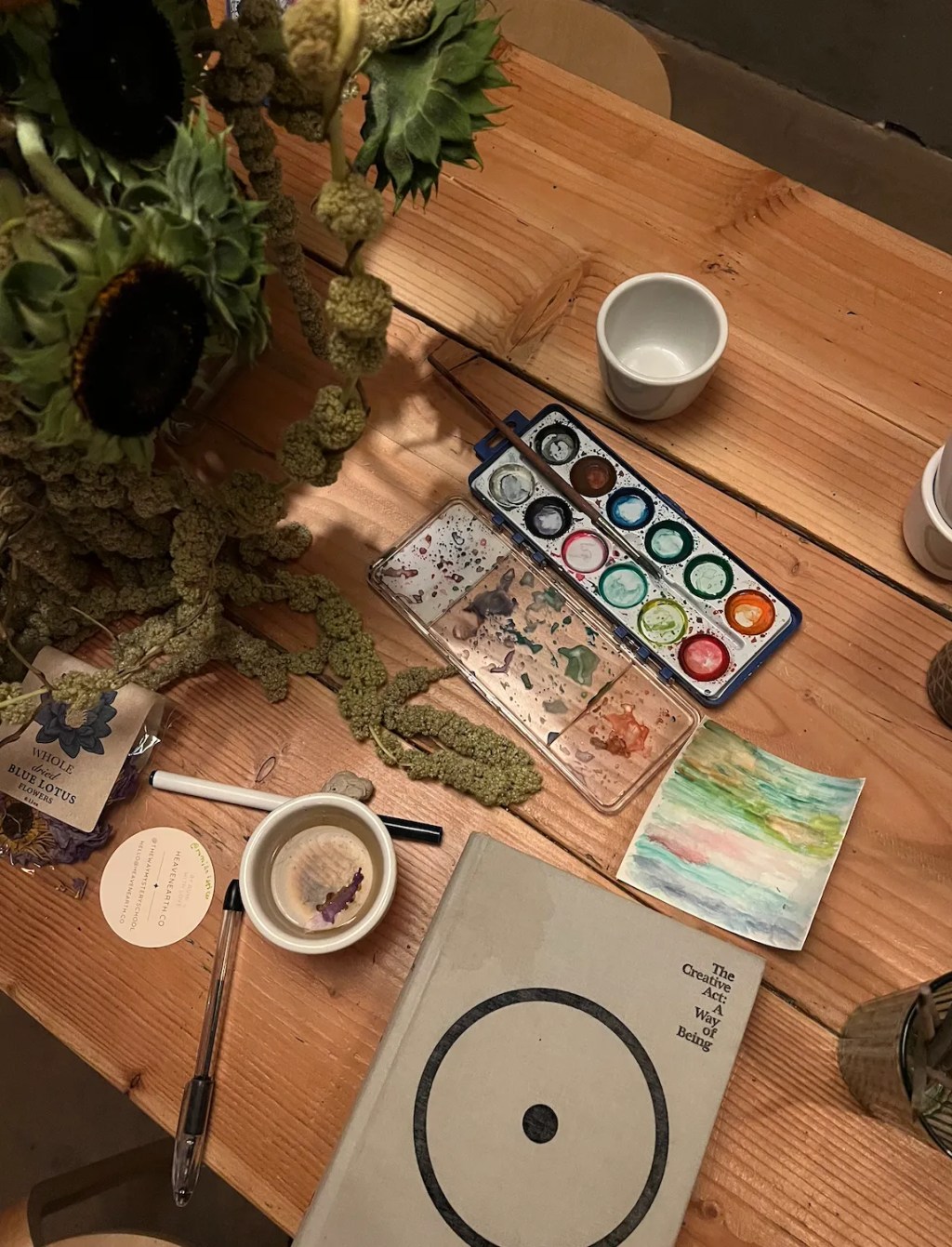
A girl once told me a story of a whole being that split itself in two so it could know the joy of reuniting its parts. The truth of wholeness was made even more precious when juxtaposed against suffering and separateness. I don’t remember the details of the story – where it came from, how to find it – but the concept reached deep within me and etched itself into my soul. We were sitting in a tea house late at night, cradling small white porcelain cups in the palms of our hands. Dim light, soft and yellow, emanated from lanterns above our heads and cast us all in a warm glow, melted our edges so we were softer, too. The chatter around us was constant but hushed, reverent, combined in quiet symphony with the undercurrent of music. The space demanded sincerity, pried hearts open with its spirit. We talked about life as a series of great rememberings, moments where we move beyond barriers that exist between us and everything around us, when we break free and catch ourselves in the net of true understanding.
Dr. Keshava and I did a single reiki session the night before I was supposed to leave Sarvaguna Yoga Dhaama in Goa. I had requested it after hours of daily asana practice fatigued my shoulders to a breaking point, remembering the profound therapy I’d received from him in Dharamshala. At the end of the session, he looked at me, seriousness pressed on his otherwise serene face. “We need one more session, maybe two,” he said. I nodded and sighed in gratitude.
“What do you feel when you’re doing it?,” I asked, needing to know that there was something real keeping me rigid, something tangible that someone else could touch. “Can you feel the tension?”
“Yes,” he answered, moving his head from side to side. “In your spine.”
I am still too entrenched in my gratitude for Keshava to speak with any perspective on how meaningful it was for him to offer his time and energy like that. I’ve written and rewritten paragraphs and they all come out saccharine. But I will say this: I have encountered genuine healers and masters all over the world – people who can understand the severity of an injury with the soft touch of a hand, people who can walk you toward some unseen part of yourself to help you hold and integrate it with compassion – and I have admired none so much as Keshava. So, when he said, you’ll need two more sessions – day of departure – I said, “Bet, I will be there,” with the utmost appreciation.
We did a quick session immediately before I had to leave, only 30 minutes, and I felt tears pool in the palms of his hand while he cupped them over my eyes, warm with energy. When I left, I pressed my palms together at my chest and flattened them both over my heart while I said thank you and goodbye, and, “actually I’ll see you soon.” I walked toward my room to finish packing and stopped short, sadness like a serpent blocking my path. “Is everything okay?” He asked. “I’m just sad to leave, but I’ll be back,” I told him, with a certainty that resounded in my thoughts the following days. “Soon,” I repeated, imagining returning to Dharamshala to continue my studies. Thank you again, I called back, without turning around this time, emotion gathering in the space of my chest.
The airport is two hours away from Agonda, and I negotiated my departure time to be just a little later than would be advisable. This is standard protocol for my travel days. I always try to pack as much love as I can into the skint corners of my last day. I had spent the day running around – extra classes, a lovely ride to a different beach – and I dreaded leaving. I rushed to pay for the little gifts I’d set aside as I walked past shops throughout my time here: a little paper mache elephant with orange flowers painted onto its body and a black pashmina scarf from Kashmir. I began packing – slowly, slowly – the day before, so most of my clothes were already tucked away in my small suitcase, belly up and unzipped.
I returned to my room to finish with 15 minutes to spare before I had to leave. All of the small things I needed to consolidate seemed to multiply across the room – toiletries and books and papers that I’d scattered while I studied. At 6:30, when my car arrived, I was still moving around the room with the adeptness of someone who has never traveled before in their life, my mind entertaining the deep part of my being that was reluctant to leave.
My friends, Gabi and Gosha, walked up the steps to my room. My door was open. I was trying to will myself outside of it. “I think it’s time,” they said to me. Vicky, the school’s head staff, followed close behind to tell me my car was waiting and to help me take my bags downstairs. I walked down after him carrying my toothbrush in one hand and a pile of books in the other hand, with my water bottle balanced in the crook of my elbow. Gabi and Gosha walked behind me cradling the belongings I left on my desk, a sad and sweet little exit procession.
It was already 20 minutes past the time I was supposed to meet my driver for the long ride to the airport. When I reached the car, a few other friends were already waiting there. I was surrounded by people I hold dearly in my heart. In that moment, I was held up by the force of that love. I hugged them all goodbye, pressed my hand to my chest while I looked at their faces and sighed. The ride was long, and I used it to organize the excess I carried in my arms, hardly breathing. My sadness curdled inside of me, bubbling forcefully beneath the surface.
The time I spent at the airport is its own story. I asked the woman at the AirIndia counter in Goa, in a whisper, what I should do about my visa, knowing that it had expired the day before and assuming I could pay a fine at the airport in order to leave. She looked at my passport, took it to a senior employee wearing an elegant pink dress, and returned five minutes later saying that I wouldn’t have to do anything since I was flying home. I exhaled in relief, counted my blessings, and went through security in record time with an extra bag full of books still in my hand.
Delhi was different. I remember walking up to the counter and looking at the face of the young man with the villainous mustache, corners turned up in a sinister joke. He had a young face and it was angry when he looked at me before he opened my passport.
“No visa?” He asked me without looking up.
“Ah, I have one, but it’s a day expired.”
“Two days,” he accused. It was 1:00 am. “You drank too much in Goa? Where’s your husband?” My body burned.
“You have to go back to Goa,” he told me. “You can’t pay the fine here because you didn’t stay here.”
“I can’t go back to Goa,” I told him. “My flight leaves in three hours.” He laughed at me, then, an ugly sound full of malice, and told me to follow him.
I wish I could say I handled the first hours with composure. I did not. “I cannot go back to Goa. I have to go home,” I demanded, through tears. A man took my passport and left for an hour; the staff wouldn’t look at me or answer any questions.
“Can someone please tell me what I need to do to go home?” I pleaded to a group of airport employees, who stole sly glances at me to avoid meeting my gaze. My whole body was a vicious heartbeat. Every cell trembled. In some moments, I remembered the lesson I had just learned about Karma Yoga while I sat in the meditation room with Keshava hours before, time that felt like a generous parting gift. “I take every result as a blessing,” he’d written. I closed my eyes to try to know that, planted my feet on the ground and grasped for the anchor of my breath. For a moment, my heartbeat softened and steadied. There is a blessing here.
When I finally sat down, I called my parents and heaved my tears. “I’m stuck in Delhi,” I cried. “I don’t know how long I need to stay here.” It was Christmas Eve. All of the offices were closed for the next few days. It was 3am by then and I could hardly see straight. I turned to the woman next to me, dressed in an elegant sky blue kurta, to apologize for crying so loudly and so uncontrollably. She assured me that it was alright, and said she’d also had an issue with her travels that kept her stranded at the airport overnight. “There is a blessing here,” she said, echoing my thoughts while she patted my back, an angel haloed by fluorescent airport lights. She introduced herself as Sindhu. She took me by the hand to immigration, and asked in Hindi what needed to be done. She was calm and they heeded her request, handing me a paper of written instructions. “It could take a couple of weeks,” they said. I booked a flight back to Goa in that instant, and felt a wave of peace wash over me.
The car ride back to Agonda was noticeably different than the one on the way out. I looked out the window the entire time, reading shop signs and looking at people’s faces, studying my surroundings with a blazing intensity. My breath was deep, smooth and even. I felt like I had returned home but with a new awareness of its preciousness. Two hours passed quickly, and my driver helped me back into the same room that I’d been devastated to leave exactly one day before. My bed was made with fresh sheets pulled tight over the mattress. The bright yellow walls welcomed me back and I squealed my joy, so grateful just for the sight of my same bed, imagining the deep sleep I would have after having been awake and in motion for the 24 hours. I walked into my bathroom just to take a deep breath and set to preparing myself for a thorough shower. Keshava messaged me then to invite me down to the dining hall for dinner. I hadn’t eaten since I left, and it was a warm return. Gabi and Gosha were just finishing their meal. Their eyes widened when they saw me. They listened while I told them the story of being detained at the airport. Keshava came, too. He teased me lightheartedly and assured me that everything would be okay. “Let’s see,” he said. “What to do now?” We sat and talked together before I went back to my room to shower and sleep.
The next day unfolded in technicolor. I walked up to the yoga shala with my mat tucked under my arm, through the clearing between the palm fronds, loving the rugged earth beneath my feet more with each step. The other friends I’d said bye to the night before were already there, sipping ginger tea outside the shala. When I unrolled my mat and stepped onto it, my body was stiff from being in transit for an entire day. The joyful ache of stretches made it sing and soften. I closed my eyes to listen to the honeyed melody of Shubham’s cues, and a smile spread across my face just to be there. I didn’t think my joy could be more complete before I left. This was a feeling I could only know by leaving, just to return 24 hours later to the very same place. I stretched my arms up, body warm with movement, finally. I walked to the beach afterward to watch flecks of sunlight dance on the sea, glittering and bright, and offered my breath in gratitude to the force that pushed me to return.
Later, I asked Keshava about Reiki Level 1 initiation. He’d suggested it in passing before I left but there wasn’t any time. Now, I am learning to turn my hands into instruments of healing. It immediately feels welcome in my body, this surge of energy, hot with the fire of prayer and the desire to do something good in the world.
I wanted to reread Shantaram on my flight home.3 It was the best way I could think to honor the time I spent in India, the perfect thing to turn my attention toward for 18 hours of uninterrupted and untethered time. Instead, I am reading it while I’m grounded, and it is giving me exactly what I need. In Shantaram, Khaderbhai says, “The truth is that we are all, every one of us, every atom, every galaxy, every particle of matter in the universe, moving toward God.” I read it with an understanding I don’t believe I had the first time around. Life is a series of great rememberings: some in a small sense, like the joy of returning to something you love; and some in a grand sense, like moments when ignorance falls away and you catch a glimpse of the truth.
 nathalie shushan
Leave a comment