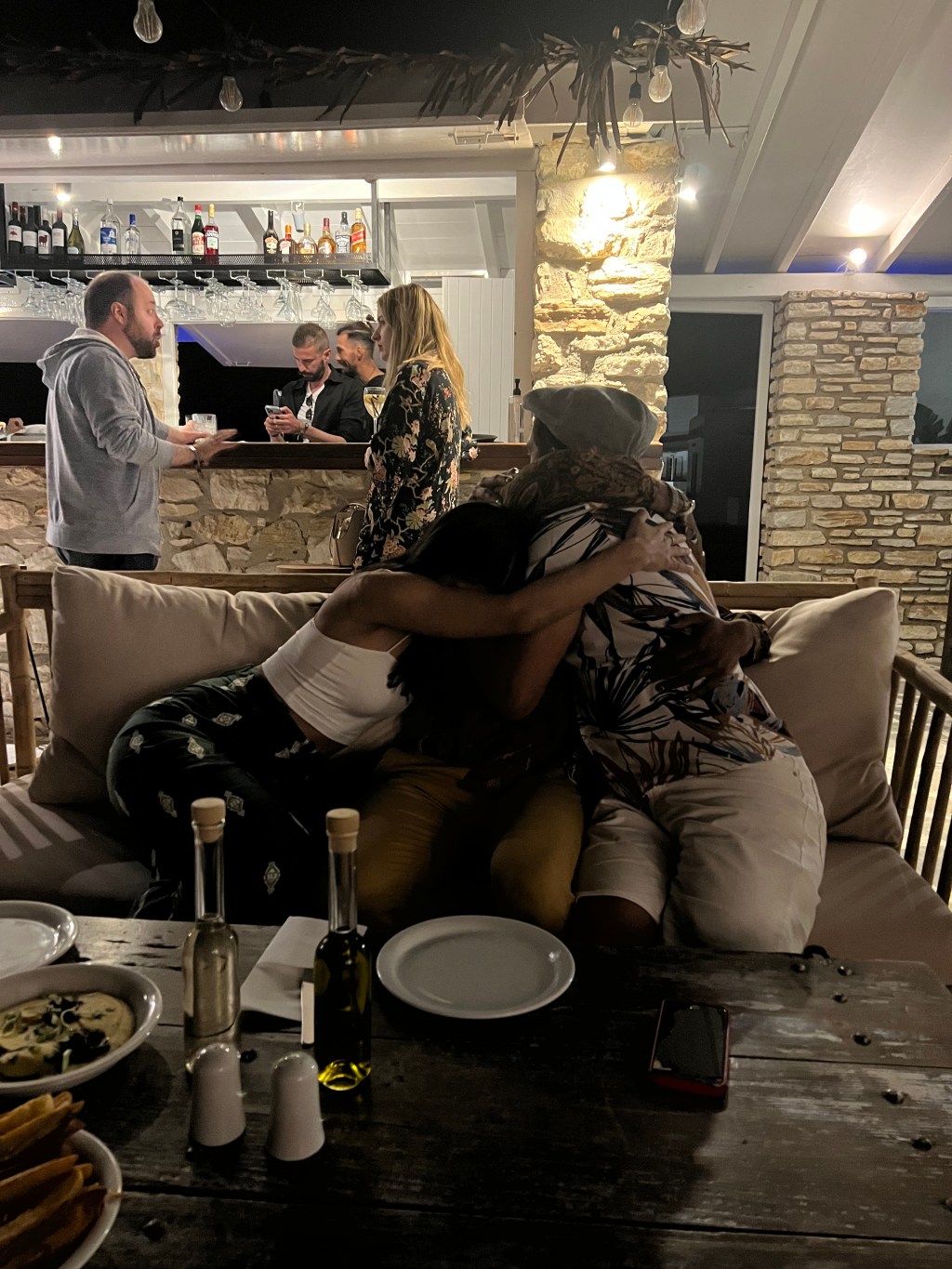
The main goal of my trip was to create a space that felt safe enough to explore the connection between my mind and body. There was a disconnect that I was desperate to resolve. All of the work I had done finally felt like it was starting to pay off when I made it to Paros. The magic of the experience came from the recognition that each person I met was on their own growth journey. There was a tangible energy of active self-betterment that was an accelerator for us all, and we were all invested in each others’ well-being.
Moshe, a friend I met in Paros, is a massage therapist whose passion for healing was immediately evident. It was essential to his being. Always eager to explore healing modalities for my stiff shoulder, I mentioned one afternoon that I’d be interested in a session. He assessed my mobility and, afterward, would occasionally stretch my arm for a few minutes in a way that would offer immediate relief.
The night before I left, our group of friends decided to have a celebratory dinner to commemorate the beautiful time we’d spent together on the island. We were all catching up near the bar, discussing future travel plans, when Moshe privately asked how my shoulder was feeling. I responded by raising my arm halfway above my head to indicate its persisting stiffness. He looked at me, calculating, and warned me that what he was about to do would be painful. Confident in my tolerance for pain, I nodded sharply at his warning and extended my arm toward him, still half participating in a conversation about my upcoming trip to the mountains. Moshe advised me to take a deep breath and implored me to heed his warning before single-handedly applying pressure so intense that I could no longer breathe. Blinded by pain, the conversation blurred into the background. I laughed nervously and closed my eyes to try to catch my breath. The sensation became more intense. With a pleading look toward the friends with whom I’d just been chatting, my laughter turned quickly into moans of pain which eventually escalated to tears. Recognizing that I was uncomfortable but undeterred, Moshe asked if I wanted to continue in a more private area. We found a secluded corner and he offered a moment of reprieve. He paused the physical exercise to explain the spiritual significance of pain in each shoulder: the left indicative of problems with receiving and the right, of problems with giving.
Still overwhelmed by the experience, I nodded, trying to understand where in my life I was giving too much or not enough. Moshe cupped my shoulder with both hands, the same way my dad would hold my head when offering a blessing, and whispered an inaudible prayer with his head bowed. The memory of my dad showing love moved me to further tears and I was shocked when Moshe, once finished with his prayer, quietly said, “I feel like I want to ask you about your father.” My sobs turned abruptly into laughter. Of course, asking after parents when considering trauma is predictable – but the immediate connection in the moment couldn’t be ignored. And the feeling that I’d been giving love to my father with an unequal reciprocation bubbled to the surface and flowed through my chest in heaving breaths, pouring out through my tears.
After my boyfriend and I broke up, all of the things I blamed my father for buckled under the weight of my sadness. I’d spent my entire life cultivating a safe space for us both in our relationship. He was deeply loving toward me and I, in turn, was endlessly forgiving in spite of all the things I knew to be true of the way he acted when I was young – his quick anger, his selfishness, his infidelity. All of the worst parts of myself that I saw in him and loved anyway. I watched our closeness erode, day after day over the course of my relationship with someone who wasn’t Jewish, until we couldn’t sit comfortably in the same room any longer.
Moshe then reminded me, bringing me back to the moment as if he were able to hear my thoughts, that our parents are of a different generation. “You know, at some point, I realized that I wanted a more affectionate relationship with my father. I asked him why, when we hung up the phone, he never told me he loved me. It took time but he eventually listened.” I could only nod in response, my eyes wide in understanding. Like my father, Moshe is Israeli. The generation before ours is one burdened by the trauma of war, plagued with an inability to communicate, held to societal standards that we are recognizing now as constraints instead of aspirations. “It doesn’t mean that he’ll do what you ask. He might not. But, by communicating your needs, you don’t have to hold onto them.” Freed by his words, by his vulnerability, I felt immediately lighter. Untethered from anger, my soul expanded in the warmth of love. I hugged Moshe hard, full of gratitude, in an attempt to express how meaningful the interaction was for me.
He advised me to pay attention. “When you notice pain in your body, ask what it could mean for your soul.” It was a lesson in magic. That night, Moshe offered me deep shoulder healing and an opportunity to listen to myself attentively. It was a powerful reminder to approach my body and my emotions with curiosity, not as separate entities but as parts of one connected self – a step of a bridge that I had been trying desperately to build.


 nathalie shushan
Leave a reply to Moshe Cancel reply