I’m reading Writing Down the Bones again. It, among other things, is making me feel brave. In Bones, Natalie Goldberg reminds us how important it is to give ourselves permission to write the “worst junk in the world.” In another chapter, entitled Composting, she says: “It takes a while for our experience to sift through our consciousness. For instance, it is hard to write about being in love in the midst of a mad love affair. We have no perspective. All we can say is, ‘I’m madly in love,’ over and over again.” It soothed me, knowing how much difficulty I had trying to offer some insight about my time in Goa when I first arrived, time slipping through my fingers like sand in an open fist.
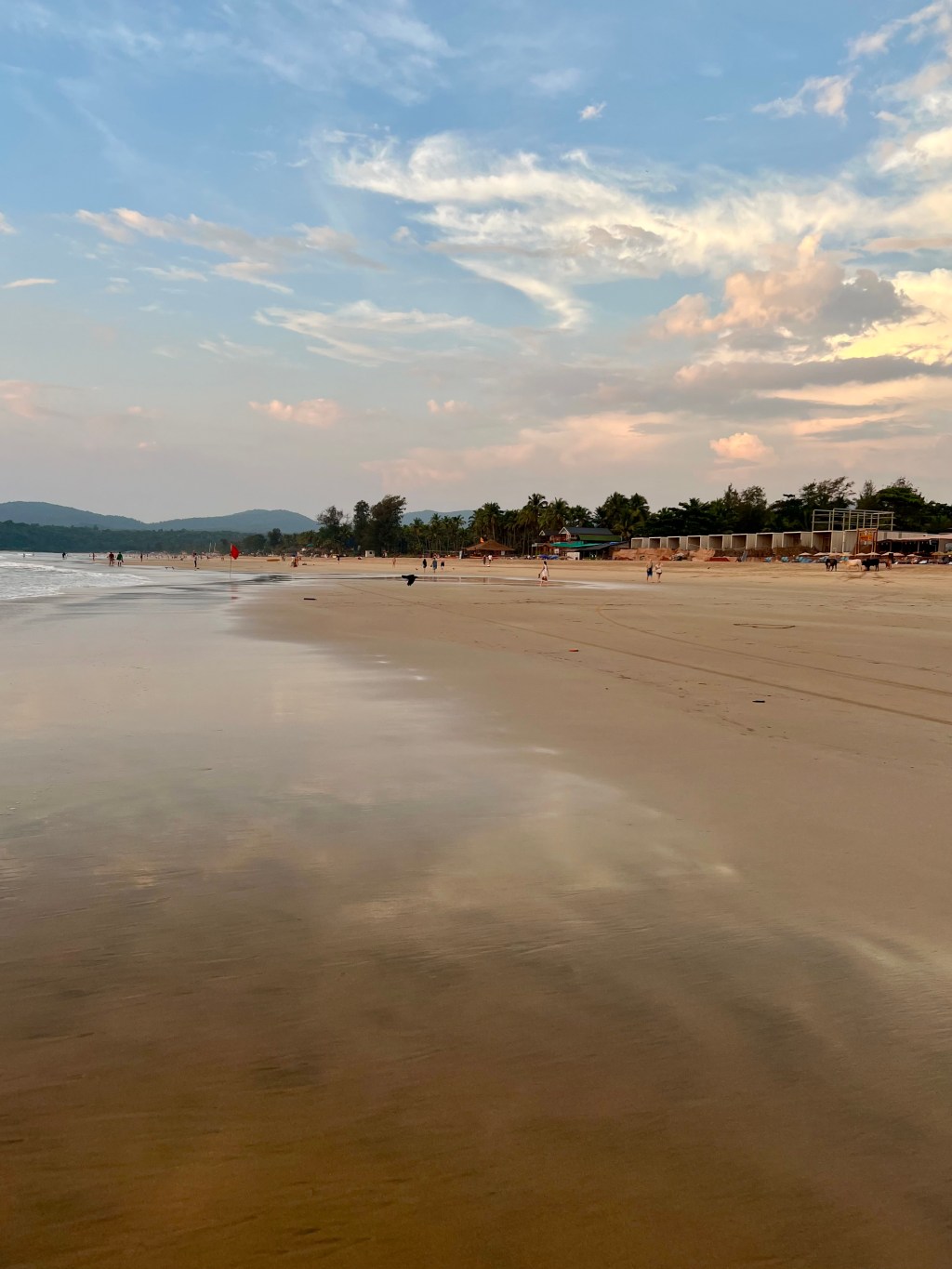
Still, I know why I wanted to capture it quickly at the beginning. When the newness of a place fades, its preciousness takes a new shape. You sink into it differently. At the beginning, it’s pristine and you can feel rigid lines of separateness that keep you awake to the details. Over time, something blurs between you and the experience or the place. You internalize it. That’s the composting, I think. In my fleeting free moments, I walk along the clay-dusted village road. I know it more intimately than I did on the first day. I say hello to the shopkeepers I recognize, a slow and sincere nod with a bright smile, hand pressed against my chest. It’s only a small stretch that I know, on the main road, studded with little shops selling fresh coconuts, vials of oil, singing bowls. The Arabian Sea crashes against the shore on the other side like a metronome. I already see it with different eyes: familiar, softer – not the fresh eyes of the first day. Those can only happen once. Not to mention, we are in class most of the day – a gorgeously rigid schedule, full of meditation, philosophy, anatomy, hours of yoga, and teaching practice. Still, I try to keep my heart open to the details.
All of this learning, also, to hold against the BACKDROP OF GRIEF! But, actually, this time, the grief has become entirely entangled in the experience, threaded through in kind of a precious way, I can’t really explain it. I feel silver threads of his existence in everything, memories coming flooding back to me, especially in savasana. When my mind feels untethered from focus, he floats in: like the time he came to my yoga class in Central Park and unrolled his mat next to mine in the circle, or the last time I saw him, when I said “I’ll see you again when I come back,” and closed the door behind me, leaned against it and sobbed. In some way, I’m happy to be here now. First, I feel his everywhere-ness in a way that I might not have in New York. Maybe it would have only seemed like a there-ness, surrounded by friends talking about him (even though it’s painful to miss the funeral, to be able to mourn alongside people who knew and loved him, too). But I am also learning about mourning in a culture different from my own, and a lot of the rituals feel honest and beautiful. It’s an honor to be able to learn them here, to have prayers recited for Osa, for a smooth passage of the soul.
In Writing Down the Bones, Natalie says, “You can have parts of others live in you. ‘I am the wing of the crow that has left and will not return.’” I find myself returning to that quote, reciting it like a mantra. He has left a gaping hole in the world but there’s this idea of internalizing him in some way, swallowing the dust of his body. Now, the only thing to do is go forward with a full heart, honor him however I can, with big love and integrity and courage.


 nathalie shushan
Leave a reply to shoooshhhh Cancel reply